
Treasury-backed ecosystem is a phrase we use to describe one part of the long-term Otter Oasis structure, but it is important to explain exactly what we mean by it.
Otter Oasis uses a project-controlled Treasury to build reserves and support future ecosystem needs. It sits alongside the Rewards Pool, Bonds & Yield, Park Fund and Operations.
It does not mean Eco Rangers or Digital Participation Shares are backed by, redeemable against, or represent ownership of Treasury assets. Participants do not own a proportional share of the Treasury, the company, land or any future physical park.
That distinction matters. The Treasury aims to strengthen the project over time. It does not create an individual claim on a pool of assets.
What We Mean By A Treasury-Backed Ecosystem
When I started designing the current Otter Oasis model, one of the big questions was simple: how do we avoid building something that relies on every pound coming in being immediately spent?
A long-term project needs room to deal with opportunities, unexpected costs, development work and changing conditions. Therefore, part of the ecosystem is designed to build project reserves rather than sending every inflow towards one purpose.
This treasury-backed ecosystem approach gives the project a way to build reserves over time. That is the role of the Otter Oasis Treasury. It is intended to give the project greater financial flexibility as the ecosystem develops.
However, a Treasury is not a guarantee of success. Its strength will depend on actual funds received, how those funds are managed, future costs and the decisions made over time. Building reserves is a risk-management principle, not a promise of a particular financial outcome.
Why Separate Funding Layers Matter In A Treasury-Backed Ecosystem
One of the most important changes in the Otter Oasis design has been separating different jobs instead of expecting one wallet or one revenue stream to do everything.
Our current treasury-backed ecosystem uses distinct funding layers:
- Rewards Pool: funds made available for qualifying ecosystem rewards.
- Treasury: project-controlled reserves intended to support sustainability, flexibility and future development.
- Bonds & Yield: project-controlled productive capital that may be deployed into selected external opportunities, with risk and no guaranteed return.
- Park Fund: a dedicated project funding layer focused on the long-term physical Otter Oasis vision.
- Operations: funding for the practical costs involved in running and developing the project.
Keeping those purposes separate makes the model easier to understand. It also means the Treasury does not need to pretend to be the Rewards Pool, the Park Fund or the productive-capital layer at the same time.
How A Treasury-Backed Ecosystem Builds Reserves
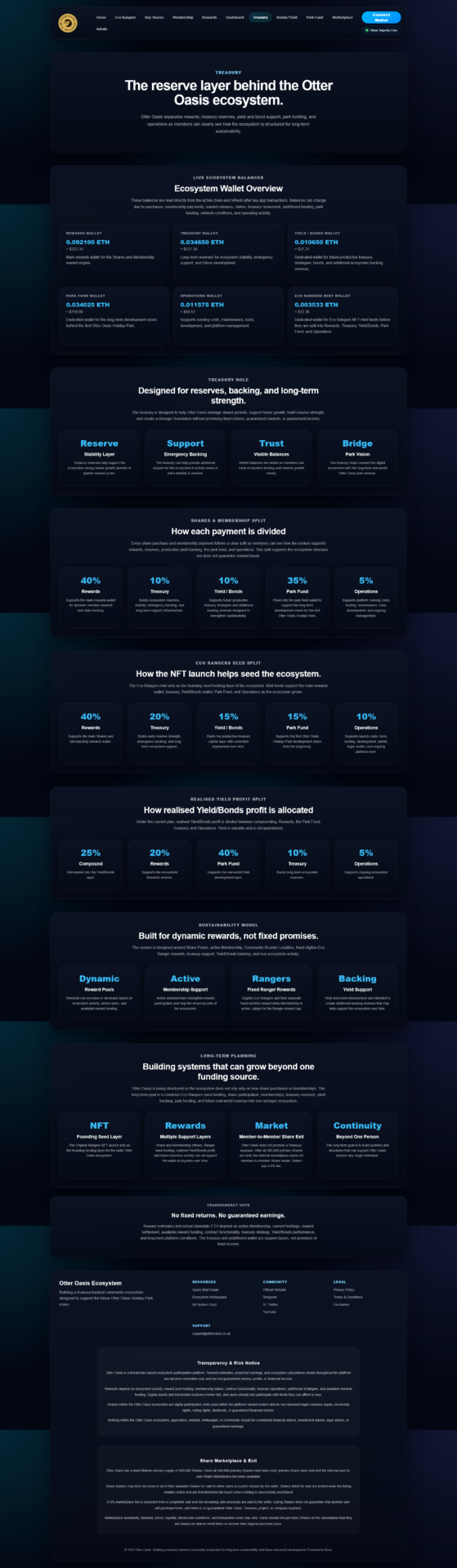
The Treasury receives defined allocations from qualifying ecosystem activity. The percentage depends on the source because different parts of Otter Oasis have different funding priorities.
Under the current model, an Eco Ranger mint allocates 20% to Treasury. The remaining allocation goes to Rewards, Bonds & Yield, Park Fund and Operations.
For primary Digital Participation Share purchases and Membership, we currently allocate 10% to Treasury. Those flows allocate 35% to the Park Fund. They also support Rewards, Bonds & Yield and Operations.
In addition, realised profit from the Bonds & Yield layer currently allocates 20% to Treasury. If the planned Marketplace becomes operational, part of its fee revenue would also go to Treasury.
These allocations describe the current ecosystem design. They do not mean these revenue streams are already active. Otter Oasis remains in its Foundation Building Stage and the app has never been publicly released.
The Treasury Is Project-Controlled
This is another point that deserves to be completely clear.
Otter Oasis controls the Treasury capital for project purposes. Holding an Eco Ranger, buying Digital Participation Shares or activating a Membership does not give someone a percentage ownership claim over the Treasury.
Likewise, Digital Participation Shares are not company shares. They do not provide company equity, voting rights, ownership of land, ownership of the future park or a right to withdraw a matching percentage of Treasury assets.
The Treasury exists for the wider project. Decisions about its use therefore need to consider the health and development of Otter Oasis as a whole rather than treating it as an individual participant account.
This is why transparency and clear documentation matter. People should be able to understand what a funding layer is designed to do without assuming rights that the system does not provide.
Treasury And Rewards Are Not The Same Thing
It can be easy to see money entering an ecosystem and think it all forms one large pot. That is not how the current Otter Oasis model is intended to work.
We use the Rewards Pool for qualifying participant rewards. The Treasury, by contrast, is a project reserve.
Separating those functions is important because using Treasury reserves as though they were automatically owed as rewards would undermine the reason for having reserves in the first place.
At the same time, having a Treasury does not mean rewards are guaranteed. Actual claimable rewards depend on the relevant Rewards Pool, the rules of the active system and the amounts available under those rules.
In short, one layer is designed around ecosystem rewards and the other around project resilience. They support the same wider vision, but they have different jobs.
Treasury And Bonds & Yield Are Different Too
The distinction between Treasury and Bonds & Yield is just as important.
We use Bonds & Yield as the project's productive-capital layer. We intend to explore carefully selected external DeFi opportunities where appropriate. Any such strategy carries risk, and there is no guaranteed APR or yield.
The Treasury has a different role. Instead, the two layers can complement each other: one focused on project reserves and flexibility, the other focused on carefully managed productive capital.
If Bonds & Yield generates realised profit, we divide it across several purposes: 25% Rewards, 20% Treasury, 40% reinvestment, 10% Park Fund and 5% Operations.
As a result, successful productive-capital activity could strengthen Treasury reserves without turning the Treasury itself into a promised yield product.
The Park Fund Has A Different Destination
The Park Fund is deliberately separate because it has a much more specific long-term purpose.
Otter Oasis ultimately aims to work towards a physical nature-focused holiday park. However, no land has been purchased, no final site has been selected and no planning permission has been secured.
The Park Fund gives project resources a dedicated route towards that physical ambition. The Treasury, meanwhile, has the broader role of supporting the ecosystem and its long-term financial foundations.
Keeping those two purposes separate helps us avoid saying that every Treasury pound is automatically park money, or that every Park Fund allocation is available for general ecosystem spending.
Why We Do Not Want To Depend On One Revenue Stream
Long-term sustainability becomes harder when a project depends entirely on one product continually selling.
That is why the current Otter Oasis model uses multiple potential sources of ecosystem activity rather than one point of dependence. Each part has a different role: Eco Rangers, Shares, Membership, productive capital and the planned Marketplace.
Not every layer is live, and none should be treated as guaranteed future revenue. However, designing several complementary routes gives the project a broader structure to build from if participation develops.
The Treasury fits into that structure by keeping part of qualifying inflows as project reserves instead of spending every inflow immediately.
Over time, the aim is simple: build more financial resilience than a model that survives only while the next sale arrives.
For broader background on why organisations hold reserves and manage liquidity, the Bank of England publishes guidance and reporting material around liquidity management. Otter Oasis is not a bank or regulated deposit product, but the general principle of planning for liquidity and reserves helps explain why we separate project capital by purpose.
Where The Treasury Stands Today
Otter Oasis is currently in the Foundation Building Stage. We have designed the ecosystem and developed the app. However, we have never publicly released it, and nobody has used the live ecosystem.
That means this article explains the structure we have built and intend to launch, not years of live Treasury performance.
Showing how we designed a system is very different from claiming that it has already proved itself. We are still building the foundations, reviewing the model, updating documentation and preparing the different parts of Otter Oasis before public participation begins.
As the project develops, we intend to keep Treasury reporting and transparency part of that process. This can help the community understand how the project manages its reserves.
How Treasury Supports The Bigger Otter Oasis Vision
The Treasury is not the destination. It supports the wider treasury-backed ecosystem as project infrastructure.
The bigger goal is to build a more sustainable ecosystem while we continue working towards the long-term Otter Oasis park vision.
That journey could take years. There will be development costs, opportunities we cannot predict today and decisions that only make sense once the project reaches later stages. Reserves can give us more choices when those moments arrive.
For me, that is the real value of the Treasury concept. It is not about making the biggest number possible appear on a dashboard. It is about giving Otter Oasis a stronger base from which to make future decisions.
Final Thoughts On A Treasury-Backed Ecosystem
A treasury-backed ecosystem, as we use the term at Otter Oasis, means building project reserves alongside the other funding layers instead of relying entirely on constant new activity.
It does not mean Rangers or Digital Participation Shares are financially backed by Treasury assets. It does not create a redemption right, equity claim or ownership interest for participants.
Instead, the Treasury forms one part of a wider structure. Rewards handles qualifying ecosystem rewards. Bonds & Yield covers productive capital. The Park Fund supports the long-term physical vision. Operations covers practical costs, while Treasury provides project reserves and flexibility.
We are still at the beginning. However, if Otter Oasis is going to pursue a vision measured in years rather than weeks, building those foundations carefully now matters.
Explore The Otter Oasis Ecosystem
Start from the Otter Oasis home page, read the Ecosystem Guide, explore the dedicated Treasury article, or see how the separate Park Fund connects the digital ecosystem with the long-term physical vision.


Pingback: Why We Chose Base for the Otter Oasis Ecosystem - Otter Oasis Adventure Park
Pingback: Otter Oasis App Build: A Sneak Peek Of What's Coming - Otter Oasis Adventure Park