

Where Every Dollar Goes is one of the most important questions we can answer about the Otter Oasis ecosystem. If people are going to understand the project, they should also understand how different sources of ecosystem revenue are intended to be allocated.
The current model does not use one universal percentage split for everything. Instead, Eco Ranger mints, primary Digital Participation Share purchases and Membership, realised Bonds & Yield profit, and the planned Marketplace each have their own allocation model.
That structure lets each source support the areas that matter most for its role while still contributing to the wider ecosystem.
Otter Oasis is currently in its Foundation Building Stage. The app has been developed, but it has never been publicly released and nobody has participated in the live ecosystem yet. Therefore, the figures below explain the current system design rather than historic live revenue.
Where Every Dollar Goes Depends On The Source
The easiest way to understand the current Otter Oasis model is to follow the money from its source.
Five core purposes appear throughout the ecosystem: the Rewards Pool, Treasury, Bonds & Yield, Park Fund and Operations. However, the percentage sent to each purpose changes depending on the type of activity.
There is also a Reinvestment allocation when realised Bonds & Yield profit is distributed, and the planned Marketplace includes a smaller Reinvestment allocation within its proposed fee split.
This approach is more accurate than saying every transaction follows the same five-wallet split. It also makes it easier to see why a particular source allocates more towards one area than another.
Where Every Dollar Goes From An Eco Ranger Mint
An Eco Ranger currently has a reference mint price of $110. Under the current model, the mint allocation is:
- 40% Rewards
- 20% Treasury
- 15% Bonds & Yield
- 15% Park Fund
- 10% Operations
Using the $110 reference price as a simple example, that would correspond to $44 for Rewards, $22 for Treasury, $16.50 for Bonds & Yield, $16.50 for the Park Fund and $11 for Operations.
The Ranger allocation gives a significant share to Rewards while also putting 60% collectively into the other project funding layers. This helps connect the founding NFT collection with the wider Otter Oasis structure rather than treating the mint as an isolated product.
Where Every Dollar Goes From Shares And Membership
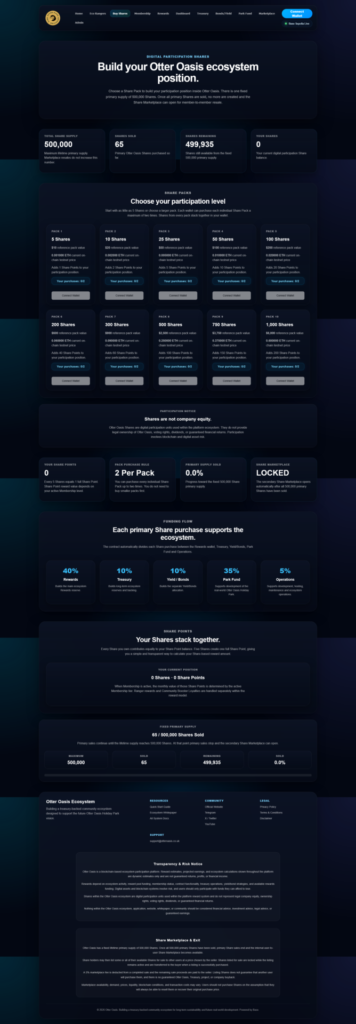
Primary Digital Participation Share purchases and Membership use a different allocation:
- 40% Rewards
- 10% Treasury
- 10% Bonds & Yield
- 35% Park Fund
- 5% Operations
The standout difference is the 35% Park Fund allocation. Shares and Membership form an important part of the long-term funding design, so this flow gives the physical Otter Oasis vision a larger allocation while still supporting the other ecosystem layers.
Digital Participation Shares are not company shares or equity. They do not provide ownership of the Treasury, land, buildings or any future park. Membership also does not create those ownership rights.
Where Every Dollar Goes From Bonds & Yield Profit
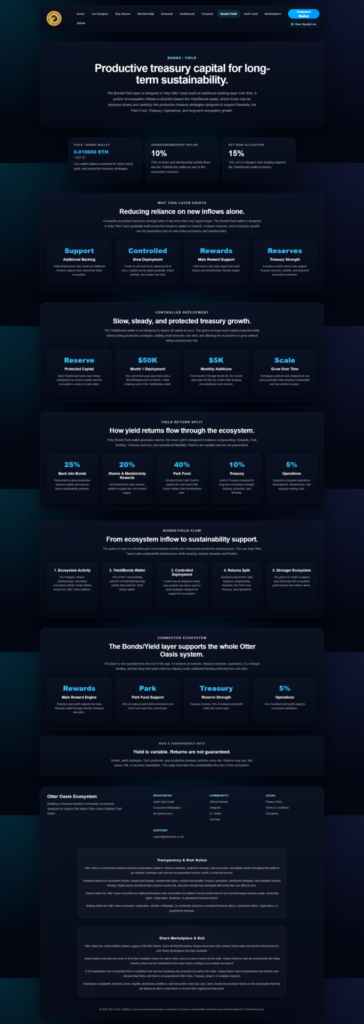
Bonds & Yield is the project-controlled productive-capital layer. It may use selected external DeFi opportunities, which involve risk. There is no guaranteed APR, yield or profit.
If the Bonds & Yield layer generates realised profit, the current profit allocation is:
- 25% Rewards
- 20% Treasury
- 40% Reinvestment
- 10% Park Fund
- 5% Operations
The 40% Reinvestment allocation is important because it allows part of realised profit to remain within the productive-capital strategy rather than distributing all profit elsewhere. At the same time, realised profit can support Rewards, strengthen Treasury reserves, contribute to the Park Fund and help cover Operations.
Again, these percentages describe how realised profit would be allocated. They do not guarantee that external strategies will produce profit.
Where Every Dollar Goes From The Planned Marketplace
The Otter Oasis Marketplace is planned and not currently live. Under the current design, the Marketplace would charge a 5% fee on qualifying marketplace transactions.
The planned allocation of that fee is:
- 50% Rewards
- 25% Treasury
- 15% Park Fund
- 5% Operations
- 5% Reinvestment
This is a future component of the ecosystem, so it should not be treated as current revenue. If the Marketplace launches as planned, its fee structure would create another source capable of supporting several ecosystem layers at the same time.
What Each Otter Oasis Funding Layer Does
The percentages make more sense when you understand the purpose behind each destination.
Rewards Pool
The Rewards Pool is the funding layer associated with qualifying ecosystem rewards. Actual claimable rewards depend on the relevant rules and the amounts available within the system. Rewards are not guaranteed simply because an allocation exists.
Treasury
The Treasury is project-controlled capital intended to build reserves, provide flexibility and support the long-term health of Otter Oasis. Participants do not own a proportional share of Treasury assets.
Bonds & Yield
Bonds & Yield provides the productive-capital layer. Its role differs from Treasury reserves because it can deploy project-controlled capital into selected external opportunities where appropriate and subject to risk.
Park Fund
The Park Fund has a specific long-term purpose connected to the physical Otter Oasis vision. Otter Oasis currently owns no park land, has not selected a final site and has no planning permission for an Otter Oasis Holiday Park.
Operations
Operations supports the practical costs of building and running the project, including development, infrastructure and other day-to-day requirements as the ecosystem progresses.
Where Every Dollar Goes: Locked Money Multisig Vaults
Knowing Where Every Dollar Goes is not only about percentages. The wallet structure behind those allocations matters too.
Otter Oasis uses Locked Money for its platform wallets, using Locked Money's multisig vault infrastructure as part of how project funds are managed. Multisig means that a wallet can require multiple authorised approvals rather than relying on a single signing key for every action.
That does not remove blockchain, smart-contract, operational or human risk. However, it adds an additional control layer to the way project wallets can be managed.
Affiliate disclosure: Otter Oasis may receive a commission if you join Locked Money through our link, at no extra cost to you. If you want to explore the platform we use, you can visit Locked Money through our affiliate link. You can also read the Locked Money documentation for independent product information.
Why Separate Allocations Matter
A single pool of money would be simpler to describe, but it would also make the purpose of project funds harder to follow.
By separating Rewards, Treasury, productive capital, the Park Fund and Operations, we can explain what each part of the ecosystem is intended to support. Different revenue sources can then place more weight on the areas most relevant to them.
For example, the Eco Ranger mint gives Treasury and Operations larger percentages than the Shares and Membership flow. Shares and Membership, meanwhile, direct 35% towards the Park Fund. Realised Bonds & Yield profit puts 40% back into Reinvestment.
Those differences are deliberate. They create a funding structure rather than forcing every type of activity through an identical split.
Transparency Matters Before Launch, Not Just After It
It would be easy to wait until the ecosystem launches before explaining the percentages. I would rather make the model understandable while we are still building it.
That is part of the reason we are publishing the Otter Oasis Ecosystem Guide and articles like this one. People should be able to see the current structure, understand what each funding layer does and distinguish the live parts of the project from future plans.
It also means we can update the documentation if the model changes before launch rather than leaving old percentages scattered across the website.
Transparency does not guarantee an outcome. What it can do is make the design easier to examine and give people better information before they decide whether the project interests them.
Where Every Dollar Goes And The Bigger Vision
The allocation model connects the digital ecosystem with the longer-term Otter Oasis vision.
Rewards are intended to support qualifying participation. Treasury builds project reserves. Bonds & Yield provides a productive-capital layer. The Park Fund creates a dedicated route towards the physical vision. Operations helps fund the work required to keep building.
None of those layers can guarantee that a future park will be built. However, separating them gives Otter Oasis a clearer structure for working towards that ambition while continuing to develop the digital ecosystem.
The goal is not simply to show percentages on a page. The goal is to explain why each percentage exists and what job it is intended to perform.
Final Thoughts: Where Every Dollar Goes
Where Every Dollar Goes in Otter Oasis depends on where that money comes from. That is the biggest difference between the current model and the older idea of one universal split.
Eco Ranger mints have one allocation. Primary Shares and Membership have another. Realised Bonds & Yield profit has its own distribution, while the planned Marketplace has a proposed fee allocation for the future.
Together, those flows are designed to support Rewards, project reserves, productive capital, the Park Fund, Operations and reinvestment where appropriate.
Otter Oasis is still building the foundation. By documenting the model now, we can give the community a much clearer picture of how the ecosystem is intended to work before public participation begins.
Explore The Otter Oasis Ecosystem
Visit the Otter Oasis home page, read the complete Ecosystem Guide, explore the Treasury, or learn more about the dedicated Park Fund.


Pingback: Personal Founder Story, My Journey To Building Otter Oasis - Otter Oasis Adventure Park
Pingback: NFT Staking Rewards: The Problem We Found - Otter Oasis Adventure Park
Pingback: Active Membership: How It Works In Otter Oasis - Otter Oasis Adventure Park
Pingback: Otter Oasis Shares Engine: How The System Works - Otter Oasis Adventure Park
Pingback: Crypto Protocols Fail Over Time: Why So Many Do - Otter Oasis Adventure Park