
Crypto protocols fail for many different reasons. Sometimes the cause is obvious: an exploit, a failed business model or a project that simply disappears. In other cases, the decline is slower. Rewards weaken, development stalls, assumptions stop working and confidence gradually disappears.
That slower type of failure can be difficult to recognise because there may be no single moment when everything breaks. A dashboard can still work and a community can still be active while the economics underneath the system become less sustainable.
Understanding those warning signs matters to anyone exploring crypto. It also matters to us at Otter Oasis, because these are exactly the kinds of structural problems we are trying to design against while the ecosystem is still in its Foundation Building Stage.
Why Crypto Protocols Fail Over Time
There is no single reason that crypto projects struggle. Some fail because of poor security. Others suffer from weak token economics, unsustainable incentives, inadequate reserves, low demand, governance problems or changing market conditions.
A common structural risk appears when a system needs continued growth simply to maintain the rewards already promised to existing participants. If new participation slows and there is no other meaningful source of value, the pressure becomes increasingly difficult to hide.
That does not mean every reward system or DeFi protocol is unsustainable. However, it does mean users should ask a basic question: where does the value actually come from?
The UK's Financial Conduct Authority guidance on high-risk investments is also a useful reminder that cryptoassets and other high-risk investments can involve significant losses.
Warning Signs Are Not Always Dramatic When Crypto Protocols Fail
People often associate crypto failure with hacks, rug pulls and sudden collapses. Those events happen, but they are not the only way a protocol can deteriorate.
Sometimes the warning signs are much quieter. Development updates become repetitive. Deadlines continually move. Reward rates change without a convincing explanation. The project's future depends increasingly on the next launch, the next influx of users or the next market cycle.
None of those signs proves that a project will fail. Markets change and legitimate development can take longer than expected. The important point is to look at the structure rather than relying entirely on optimism.
Dashboard Numbers Are Not The Same As Real Value
A displayed balance, APR or reward figure can look impressive, but the number alone does not explain where the value comes from, whether liquidity exists or whether the underlying economics are sustainable.
Likewise, compounding a number inside a protocol does not automatically mean productive value is being created. Users need to understand the assets, risks, revenue sources and assumptions behind the figure.
Growth Can Hide Structural Weakness
Rapid growth can make a weak model look healthy for a period of time. New capital, attention and activity can support incentives that become much harder to maintain once growth slows.
That is why sustainability matters more than headline growth. A resilient structure should be able to explain how different costs, reserves and reward mechanisms are funded without assuming that participation will increase forever.
When Hope Replaces Evidence
Another risk is psychological rather than technical. Once somebody has invested money and time into a project, walking away can become difficult. The decision may start to revolve around recovering past losses instead of assessing the opportunity as it exists today.
This is why transparent information matters. Participants should be able to reassess a project when circumstances change rather than feeling pressured to remain involved because they have already spent months or years supporting it.
No ecosystem can remove every risk. Clear documentation, realistic assumptions and visible rules can at least make those risks easier to evaluate.
What Otter Oasis Learned From These Problems
Otter Oasis has changed substantially during development. Earlier versions of the concept included mechanics such as Reward Power, percentage boosters and other structures that are no longer part of the current model.
Because the app has never been publicly released and nobody has participated in the live system, we have been able to revise those mechanics during development rather than pretending an older design must be preserved simply because it came first.
The current approach separates the ecosystem into identifiable funding and participation layers. Digital Participation Shares, Membership, Eco Rangers, the Rewards Pool, Treasury, Bonds & Yield, Park Fund and Operations each have a defined role.
That does not prove Otter Oasis cannot fail. It means we are trying to build around lessons that can be seen across crypto rather than ignoring them.
Defined Allocations Instead Of One Pot
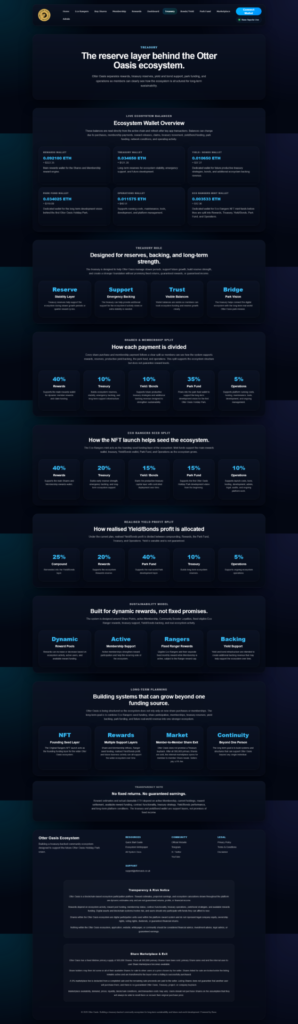
One part of the current design is the use of defined allocations. For example, primary Digital Participation Shares and Membership payments currently use the following structure:
- 40% Rewards
- 10% Treasury
- 10% Bonds & Yield
- 35% Park Fund
- 5% Operations
The aim is to give different parts of the ecosystem different jobs. The Treasury is a project-controlled reserve layer. The Park Fund is dedicated to the long-term physical park vision. Operations supports the costs of building and running the ecosystem. Meanwhile, the Rewards allocation supports the Rewards Pool.
You can see the wider funding structure in Where Every Dollar Goes In Otter Oasis.
Rewards Need A Funding Source
One lesson from unsustainable crypto models is that a reward figure should not be treated as if it exists independently of its funding source.
In the current Otter Oasis model, Share Point and Eco Ranger figures are described as reference calculations rather than guaranteed returns. Actual claimable rewards depend on the Rewards Pool, amounts credited under the system and the applicable rules.
This distinction matters. A reference calculation can explain how a system accounts for participation without pretending that a fixed payment is guaranteed regardless of what happens elsewhere in the ecosystem.
The dedicated Shares Engine guide explains how the current Share Point model works.
Productive Capital Still Carries Risk
The Bonds & Yield layer is intended to provide a productive-capital component within Otter Oasis. Project-controlled funds may be deployed into selected external DeFi opportunities where appropriate.
However, yield is not free money. External protocols introduce smart-contract risk, market risk, liquidity risk and platform risk. Returns can change and losses are possible. For that reason, Otter Oasis does not present the Bonds & Yield layer as a guaranteed APR.
Realised profits, when they exist, have their own allocation model rather than being treated as guaranteed income before they are earned. You can read more in our Bonds & Yield guide.
The Physical Park Is A Vision, Not A Guarantee
The long-term Otter Oasis vision includes a physical nature-focused destination built around wildlife, fishing, accommodation and family experiences. However, it is important to separate that ambition from what exists today.
Otter Oasis has not acquired the final park site and does not have planning permission for a park. Therefore, we should not use a future physical development as though it were guaranteed revenue already sitting behind the ecosystem.
The Park Fund exists as a dedicated funding layer for that long-term goal. It is not proof that the park will be built, nor does participation provide ownership of future land, buildings or physical assets.
Our Holiday Park vision explains that longer-term objective separately.
Transparency Helps, But It Does Not Remove Risk
Blockchain infrastructure can make relevant on-chain transactions and wallets publicly viewable. Clear documentation can explain allocations and rules. Neither of those things makes a project risk-free.
Transparency is valuable because it gives people more information with which to make their own decisions. It should not be used as a substitute for due diligence or as evidence that a particular outcome is guaranteed.
This is also why the current Otter Oasis structure makes a clear distinction between participation and ownership. Digital Participation Shares and Eco Rangers do not provide equity in the company, voting rights, ownership of the Treasury or Park Fund, or ownership of future physical assets.
Building Before Public Participation
Otter Oasis is currently in its Foundation Building Stage. The app and core ecosystem architecture have been developed, but the app has never been publicly released.
That gives us an opportunity to question assumptions before public participation begins. If a mechanic is unnecessarily complicated, misleading or difficult to fund sustainably, it can be changed during development.
We would rather document those changes than pretend the project arrived fully formed. Building a stronger structure means being willing to replace ideas when a clearer approach becomes available.
What To Look For When Assessing For A Crypto Protocols Fail
No checklist can predict whether a crypto project will succeed. Still, a few questions can help people assess what they are looking at:
- Where do rewards or yield actually come from?
- Does the system depend heavily on continual new participation?
- Are risks explained alongside potential benefits?
- Can important on-chain activity be independently checked?
- Are project-controlled funds and participant ownership clearly distinguished?
- Does the team update the model when assumptions change?
- Are future plans presented as goals rather than guaranteed outcomes?
Those questions apply to Otter Oasis as much as they apply to any other project. Readers should assess the evidence, understand the risks and make their own decisions.
Final Thoughts On Why Crypto Protocols Fail
Crypto protocols fail for technical, financial, economic and organisational reasons. Sometimes failure is sudden. Sometimes it is a slow loss of sustainability and confidence.
For Otter Oasis, the useful lesson is not to claim that our structure makes failure impossible. It is to keep asking where funds come from, what each layer is designed to do, what risks remain and whether our public explanations match the system being built.
That is the standard we want to carry through the Foundation Building Stage and beyond.
To understand the current Otter Oasis structure in more detail, read the Otter Oasis Ecosystem Guide.



Pingback: Sustainable DeFi Projects: What Makes A Model Last?