
Sustainable DeFi Projects need more than high yields and exciting launch numbers. If a blockchain ecosystem is expected to survive for years, its rewards, reserves, risk management and sources of capital all need to make economic sense.
That lesson has become increasingly important across decentralized finance. High returns can attract attention quickly, but a reward system is only sustainable if there is a credible source behind those rewards and the project can continue operating when market conditions become difficult.
Otter Oasis has changed considerably since this article was first published. Earlier token, staking and liquidity-farm ideas are no longer the current model. Today, the project is being developed around separate funding layers including a Rewards Pool, Treasury, Bonds & Yield, Park Fund and Operations.
Why Sustainable DeFi Projects Need Real Economics
DeFi can create useful financial tools without traditional intermediaries. However, decentralization does not remove basic economics.
If a system continually pays out more value than it generates or receives, something eventually has to fill that gap. In some models that may be token inflation, new participant money, depleted reserves or increasingly risky strategies.
High advertised yields can therefore be misleading when the source of those yields is unclear. A percentage on a dashboard does not automatically mean genuine profit has been generated.
A more sustainable approach starts with a simpler question: where does the money actually come from?
That is also one of the themes explored in our article Crypto Protocols Fail Over Time, which looks at some of the structural reasons blockchain projects can struggle to survive.
Yield And Rewards Are Not The Same Thing
One useful distinction is the difference between yield that has actually been generated and rewards distributed by an ecosystem.
Realised yield may come from productive capital deployed into an external opportunity. Rewards, meanwhile, can come from a separate pool funded by defined ecosystem allocations.
Those two things should not be presented as interchangeable.
In the current Otter Oasis model, the Rewards Pool is a dedicated funding layer. Eco Ranger mint allocations direct 40% to Rewards. Primary Digital Participation Share and Membership allocations also direct 40% to Rewards.
This makes the source of the reward funding easier to understand. However, it does not make future payouts guaranteed. Actual claimable amounts still depend on the Rewards Pool, credited amounts, applicable rules and the operation of the ecosystem.
A Treasury Can Provide Resilience, Not Guaranteed Returns
A project Treasury can play an important role in long-term sustainability when its purpose is clearly defined.
The Otter Oasis Treasury is project-controlled capital intended to support reserves, ecosystem sustainability and future project needs. It is not a pot that participants own proportionally.
Under the current Eco Ranger allocation, 20% goes to Treasury. Primary Share and Membership allocations direct 10% to Treasury.
Building reserves can give a project more flexibility when markets change or unexpected costs appear. At the same time, a Treasury is not a guarantee against losses and it should not be described as automatically backing the value of every digital asset in the ecosystem.
Good treasury design is therefore about resilience and responsible capital management rather than promising a particular return.
Bonds & Yield Adds A Productive Capital Layer
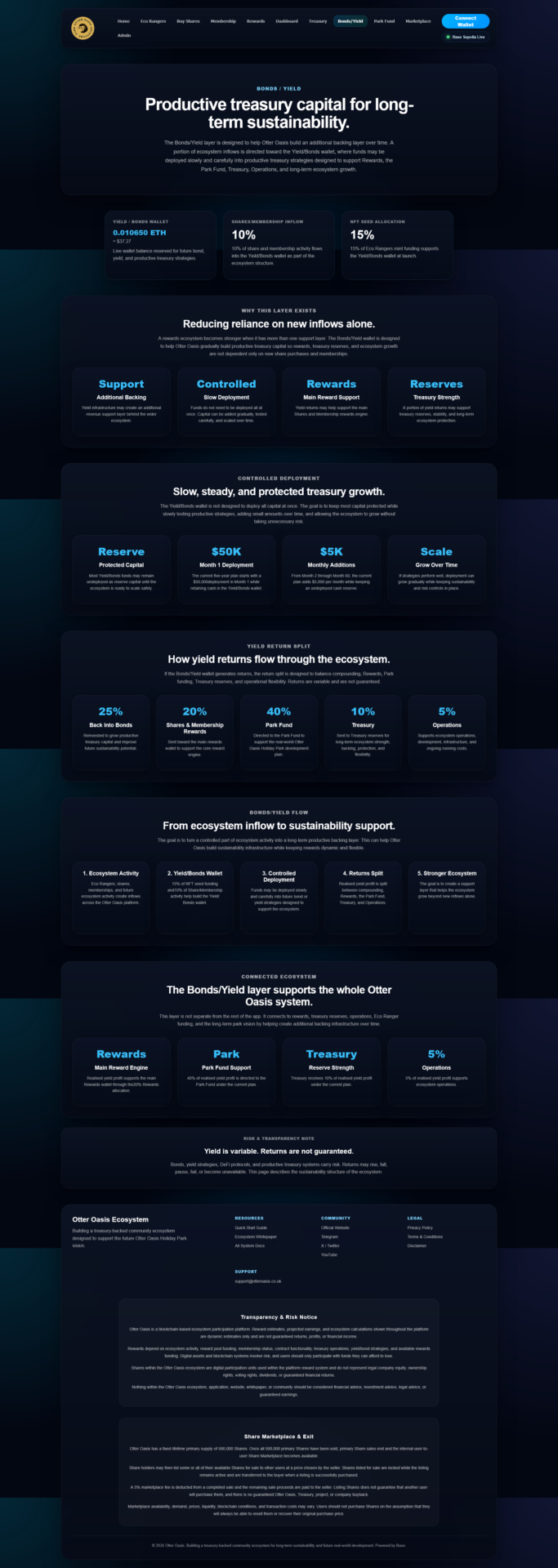
The Bonds & Yield layer is where Otter Oasis can explore putting a portion of project-controlled capital to productive use.
The current planning approach is gradual. An initial allocation of around $50,000 has been discussed as a reference point, followed by approximately $5,000 per month when funding, market conditions, risk and project decisions allow.
These are planning references, not guaranteed deployment amounts.
Capital may be deployed into external DeFi opportunities. Consequently, it can face smart-contract risk, protocol risk, market risk, liquidity risk and other forms of loss. No fixed APR or guaranteed yield should be assumed.
This is deliberately different from an old-style model that promises a fixed percentage simply because capital has been deposited.
Realised Profit Can Be Split Between Today And Tomorrow
A sustainable system also needs to decide what happens after productive capital actually generates profit.
Under the current Otter Oasis Bonds & Yield model, realised profit is allocated across several purposes:
- 25% Rewards
- 20% Treasury
- 40% Reinvestment
- 10% Park Fund
- 5% Operations
The important word is realised. This allocation applies to profit that has actually been generated. It is not a promise that a particular amount of profit will exist each month.
The 40% reinvestment allocation is particularly relevant to sustainability. Rather than distributing everything that is earned, part of the realised profit can remain productive and potentially help the capital base grow over time.
Reinvestment Can Matter More Than Headline Yield
It is easy to market a DeFi project using a large APR or APY. However, headline yield alone says very little about whether the underlying system is healthy.
A project that distributes every penny it earns may have little room to strengthen reserves or expand productive capital. A project that continually reinvests a portion of genuine profit has a different economic structure.
That does not remove risk. Reinvested capital can still lose value, and future opportunities may produce lower returns than previous ones.
Nevertheless, retaining part of realised profit can reduce the pressure to extract everything immediately. The focus shifts from maximising today's payout to trying to build a stronger capital base for tomorrow.
Sustainable DeFi Projects Need Several Funding Layers
One reason the current Otter Oasis ecosystem separates its funding is to avoid expecting one wallet or one mechanism to do every job.
The Rewards Pool supports ecosystem rewards. Treasury supports reserves and sustainability. Bonds & Yield handles productive capital. The Park Fund is dedicated to the long-term physical park vision. Operations supports the costs involved in running and developing the project.
Those layers receive different percentages depending on the activity generating the funds.
For example, Eco Ranger mint allocations currently use 40% Rewards, 20% Treasury, 15% Bonds & Yield, 15% Park Fund and 10% Operations.
Primary Digital Participation Share and Membership allocations use 40% Rewards, 10% Treasury, 10% Bonds & Yield, 35% Park Fund and 5% Operations.
You can see how those pieces connect in Funding Layers.
Real-World Ambition Does Not Remove DeFi Risk
Otter Oasis also has a long-term physical ambition: a future holiday and adventure park built around fishing, wildlife, accommodation, food and family activities.
That real-world vision can give the ecosystem a purpose beyond activity on a blockchain. However, it should not be used to imply that DeFi capital is automatically protected by future park assets.
There is currently no final park site, no planning permission and no construction underway. Digital Participation Shares are not company equity and do not provide ownership of land, buildings or the future park.
Likewise, the Treasury and Bonds & Yield capital remain project-controlled. Participants do not receive a proportional ownership claim over those assets.
Keeping those distinctions clear is part of building a more responsible ecosystem.
Transparency Helps People Understand The Risk With Sustainable DeFi Projects
Otter Oasis is being developed on Base. Using a public blockchain can make on-chain transactions independently visible and verifiable.
That transparency can help people see movements between blockchain addresses and contracts. Still, blockchain records do not prove everything that happens off-chain, and transparency does not eliminate investment or protocol risk.
A sustainable project therefore needs more than a block explorer. It also needs understandable documentation, clear allocations, realistic language and regular updates as the model changes.
When an old idea is replaced, the public information should eventually change with it. That is exactly why articles like this one are being rewritten as the Otter Oasis ecosystem develops.
No Fixed Yield Means No Fixed Promise
The current Otter Oasis approach deliberately avoids promising a fixed return from Bonds & Yield.
External DeFi conditions can change quickly. A strategy that is attractive today may become less attractive tomorrow, while a protocol considered established can still encounter technical, economic or governance problems.
For that reason, deployment decisions have to consider risk as well as potential return.
There may be periods when less capital is deployed, strategies change or realised yield is lower than hoped. A sustainable model has to be capable of acknowledging those possibilities instead of building its entire economics around an assumed percentage.
Sustainability Is A Design Goal, Not A Guarantee
No DeFi architecture can guarantee that a project will succeed indefinitely.
Markets change. Smart contracts can fail. External protocols can suffer losses. Operating costs can rise, regulations can evolve and assumptions that once looked sensible can prove wrong.
So when we talk about sustainable DeFi projects, sustainability should be treated as a design objective, not a promise.
For Otter Oasis, that means separating funding layers, avoiding guaranteed APR claims, building reserves, reinvesting part of realised profit and connecting the digital ecosystem to a broader long-term project without pretending the future park already exists.
Where Otter Oasis Stands On Sustainable DeFi Projects Today
Otter Oasis is currently in the Foundation Building Stage.
The app has never been publicly released and nobody has participated in a live Otter Oasis ecosystem. The current work is focused on building and testing the structure, contracts, documentation and wider project model before any public ecosystem launch.
That gives us the opportunity to keep improving the economics before they have to operate at scale.
The goal is not to claim that Otter Oasis has solved DeFi sustainability. It is to build a structure that learns from the weaknesses seen in short-term models and gives each part of the ecosystem a clear job.
Explore the full structure in the Otter Oasis Ecosystem Guide, or start from the Otter Oasis home page.


Pingback: Otter Oasis Seed Rounds, Why Early Investors Win - Otter Oasis Adventure Park
The DeFi space is maturing and sustainability is the new alpha.
Otter Oasis isn’t chasing trends; it’s laying foundations.
$PBT is built for real world integration, not just momentary hype.
This is where long,term conviction meets real utility.