Otter Oasis Ecosystem Loop explains how the main parts of the current ecosystem are designed to connect. Eco Rangers, Digital Participation Shares, Membership, Rewards, Treasury, Bonds & Yield, the Park Fund and Operations each have a different job, but they are intended to work as one wider funding structure.
The idea is not that one product funds everything forever. Instead, primary participation revenue is divided between several ecosystem destinations. In addition, productive capital may create further support, while the long-term Park Vision could eventually introduce genuine real-world operating revenue.
However, this is a developing model rather than a guaranteed financial cycle. Rewards depend on funded and credited amounts, external yield strategies carry risk, and the future physical park depends on funding, land, planning and many other factors.
Where the Otter Oasis Ecosystem Loop Begins
The current loop begins with three participant-facing layers: Eco Rangers, Digital Participation Shares and Membership. Each contributes to the wider ecosystem in a different way.
Eco Rangers are the founding digital collection. Digital Participation Shares provide on-chain participation units, while Membership activates the current monthly Share Point reward framework and can make eligible Eco Rangers in a connected wallet part of the current Ranger reward calculation.
Importantly, none of these products provides company equity, voting rights, ownership of the Treasury, ownership of land or an ownership interest in a future Otter Oasis park.
Stage 1: Eco Rangers Seed the Ecosystem
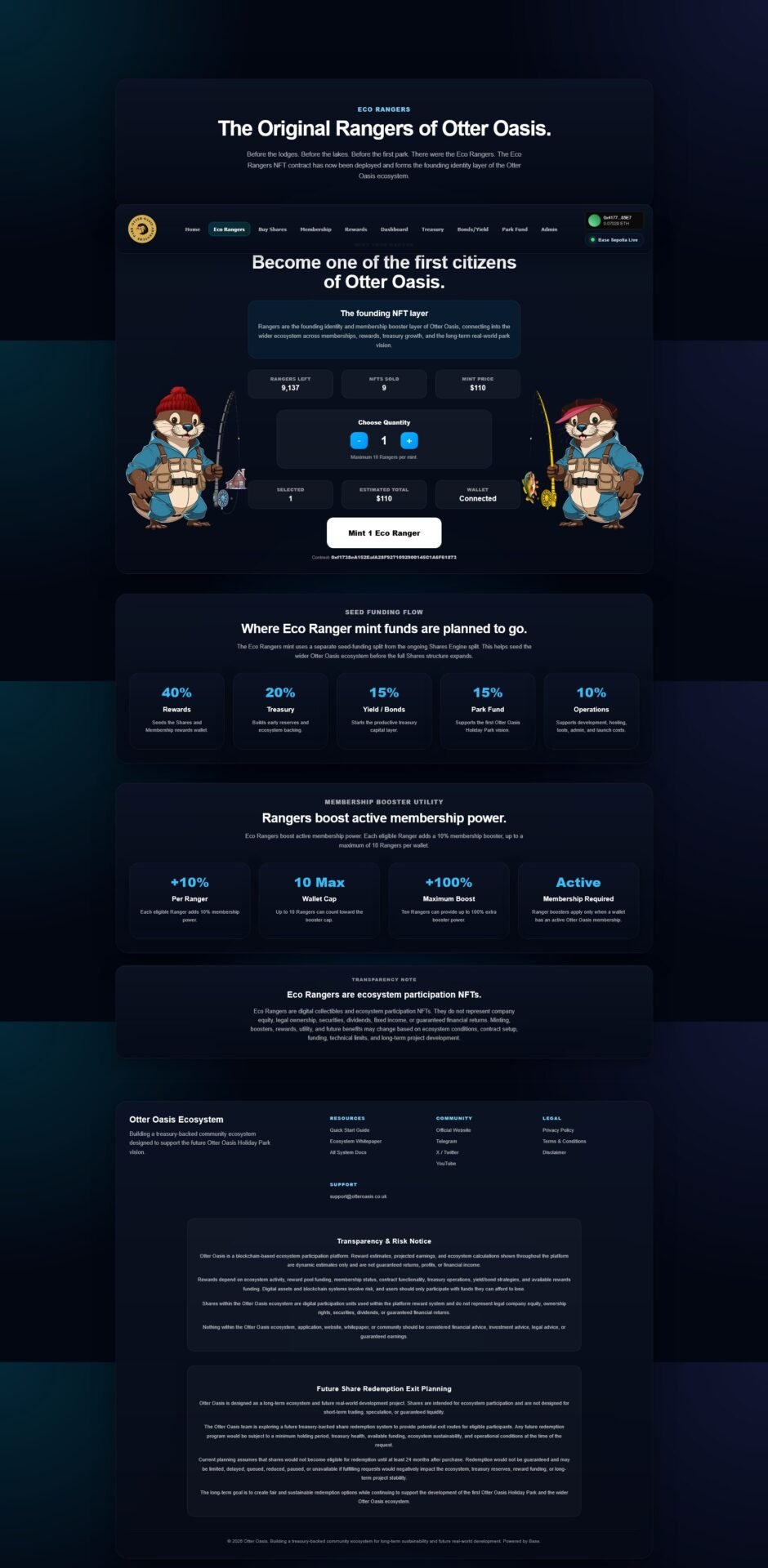
There are 9,146 Eco Rangers, with a current mint reference price of $110. Primary Eco Ranger revenue currently follows this allocation:
- 40% Rewards Pool
- 20% Treasury
- 15% Bonds & Yield
- 15% Park Fund
- 10% Operations
As a result, a Ranger mint can support several parts of Otter Oasis at the same time rather than sending all primary revenue to one destination.
Stage 2: Shares and Membership Provide Ongoing Support
Digital Participation Shares and Membership use the same current primary revenue allocation:
- 40% Rewards Pool
- 10% Treasury
- 10% Bonds & Yield
- 35% Park Fund
- 5% Operations
Digital Participation Shares have a current lifetime primary supply cap of 500,000. Under the current system, every five Shares equal one Share Point for platform reward calculations.
Shares can be held without an active Membership. However, the current monthly Share Point reward calculation requires an active Membership, and the Membership tier determines the current monthly reference amount assigned to each Share Point.
The Current Membership Structure
- Starter: $10/month, current $0.15 per Share Point monthly reference and $1 Community Builder Loyalty reference.
- Plus: $25/month, current $0.20 per Share Point monthly reference and $2 Community Builder Loyalty reference.
- Basic: $50/month, current $0.30 per Share Point monthly reference and $3 Community Builder Loyalty reference.
- Pro: $100/month, current $0.35 per Share Point monthly reference and $7.50 Community Builder Loyalty reference.
- Premium: $200/month, current $0.50 per Share Point monthly reference and $15 Community Builder Loyalty reference.
In addition, an active Membership can currently make up to 10 Eco Rangers in the connected wallet eligible for the Ranger reward calculation. The current reference is $5 per eligible Ranger per month, subject to the Rewards Pool and amounts actually credited. These figures are current platform references, not guaranteed earnings, interest or dividends.
Stage 3: Revenue Is Split Across Five Core Destinations
The Otter Oasis Funding Layers are easier to understand when each destination is given a clear job.
- Rewards Pool: supports funded participant reward claims when amounts are credited.
- Treasury: builds project-controlled reserves for longer-term ecosystem requirements.
- Bonds & Yield: develops a separate productive-capital strategy.
- Park Fund: creates a dedicated funding route toward the long-term physical Otter Oasis vision.
- Operations: supports the work and costs involved in developing and operating the ecosystem.
Therefore, primary participation revenue does not simply move from a buyer to a reward wallet. It is distributed across several purposes that are intended to develop different parts of the project.
Stage 4: Treasury Builds a Reserve
The Otter Oasis Treasury is intended to retain part of the ecosystem's resources for future project needs and opportunities. It is separate from participant Rewards and separate from the Park Fund.
For example, the Treasury currently receives 20% of primary Eco Ranger revenue and 10% of primary Share and Membership revenue. It can also receive allocations from realised Bonds & Yield profit and marketplace fees.
Consequently, the Treasury can potentially grow from several ecosystem activities rather than depending on one source alone. Treasury assets remain project-controlled and are not owned by Ranger, Share or Membership holders.
Stage 5: Bonds & Yield Aim to Create Productive Capital
The Bonds & Yield layer is designed to put a portion of project-controlled capital to productive use. The current working approach is gradual deployment rather than committing all available capital at once.
One type of opportunity being explored is bond-based DeFi. For an example of the kind of blockchain protocol involved, readers can research DexFi Bonds independently.
Disclosure: This is an affiliate link. Otter Oasis may receive a referral benefit if you use it, at no additional cost to you. Any referral benefit received also helps support the continued development of the Otter Oasis ecosystem.
External DeFi strategies carry smart-contract, protocol, liquidity, counterparty, market and regulatory risks. Therefore, quoted yields can change and capital can be lost.
Stage 6: Realised Yield Feeds Back Into the Ecosystem
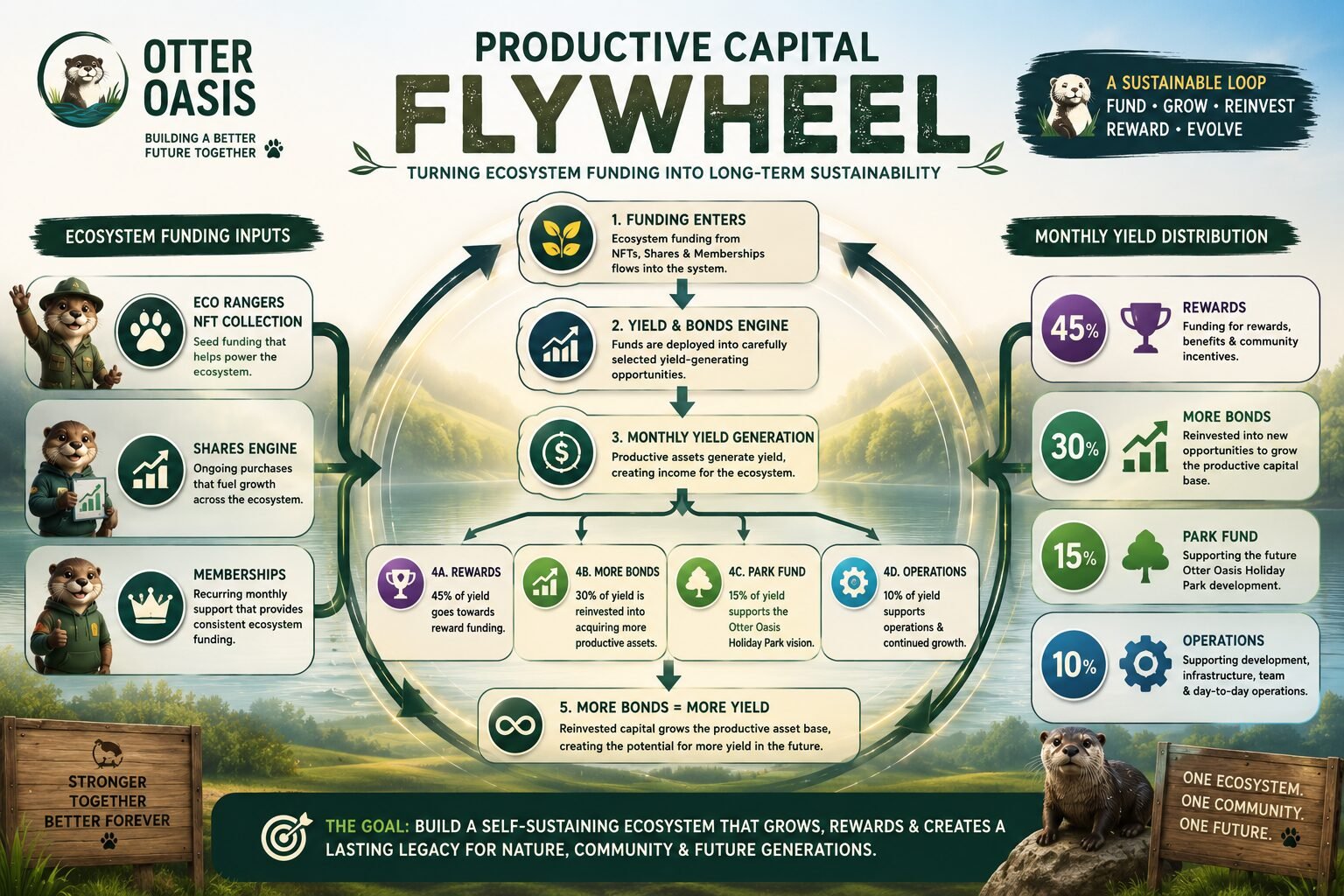
If Bonds & Yield activity produces realised profit, the current intended allocation is:
- 25% Compounding / Bonds Capital
- 20% Rewards
- 40% Park Fund
- 10% Treasury
- 5% Operations
Importantly, this is the allocation of realised Bonds & Yield profit. It is not the allocation applied to the original Eco Ranger, Share or Membership purchase.
The 25% compounding allocation is the part that can feed productive capital back into the strategy. Meanwhile, other portions can support Rewards, the Park Fund, Treasury and Operations. That is the core of the loop concept.
The Otter Oasis Ecosystem Loop in Simple Terms
The current model can be summarised like this:
- Eco Rangers help establish the founding funding base.
- Shares and Membership provide additional and recurring participation revenue.
- Primary revenue is allocated across Rewards, Treasury, Bonds & Yield, Park Fund and Operations.
- Treasury retains project-controlled reserves.
- Bonds & Yield may deploy capital into selected productive strategies.
- Realised yield profit can be divided between compounding and other ecosystem destinations.
- The Park Fund accumulates dedicated capital toward the long-term physical vision.
In other words, the loop is intended to create several routes through which one part of the ecosystem may help strengthen another.
The Share Marketplace Adds Another Loop
The current ecosystem design also includes a future internal Share marketplace. When a marketplace transaction incurs the current 5% ecosystem fee, that fee is intended to be allocated as follows:
- 50% Park Fund
- 25% Rewards
- 15% Treasury
- 5% Bonds & Yield
- 5% Operations
Therefore, secondary Share activity could create another source of support for the wider ecosystem rather than the marketplace fee being treated as a single-purpose charge.
Where the Park Fund Fits Into the Loop
The Park Fund is the bridge between the digital ecosystem and the long-term real-world Otter Oasis vision. It receives 15% of primary Eco Ranger revenue and 35% of primary Share and Membership revenue under the current model. In addition, it is intended to receive 40% of realised Bonds & Yield profit and 50% of the marketplace ecosystem fee allocation.
Potential future uses may include research, professional services, feasibility work, land-related costs, planning and development. However, no land purchase, planning approval, construction date or park opening is guaranteed.
Future Real-World Revenue Could Extend the Loop
The long-term vision is not for Otter Oasis to remain dependent only on digital participation. If a real-world destination is eventually developed and operated successfully, activities such as accommodation, fishing, food and drink, events and outdoor experiences could potentially create additional project revenue.
Nevertheless, that revenue does not exist today and should not be treated as guaranteed future income. The physical project will depend on sufficient funding, suitable land, planning and other approvals, professional advice, legal structure and commercial viability.
If successfully developed, real-world revenue could add another funding source to an ecosystem already supported by several digital and productive-capital layers.
Why the Ecosystem Loop Is Not a Guarantee
A loop on paper only becomes useful when the individual parts actually perform. Membership levels can change, Share activity can vary, external strategies can lose money and the cost of developing a physical park can change significantly.
Furthermore, blockchain applications and smart contracts carry technical risks, while regulation can affect how digital-asset systems operate. For that reason, projections should never be treated as guaranteed returns.
Anyone considering participation should read the current Risk Disclosure and Otter Oasis documentation and make their own decision based on the current system rather than future assumptions.
The Bigger Picture
The Otter Oasis Ecosystem Loop is ultimately about diversification. Instead of asking one product to fund Rewards, reserves, development and a future park on its own, the current model gives different funding streams and wallets different jobs.
Over time, the aim is for primary participation revenue, Treasury reserves, productive capital, marketplace activity and potentially real-world business revenue to form a broader support structure.
That outcome is not guaranteed. However, it explains why the different pieces of Otter Oasis have been designed to connect rather than operate as isolated products.
Explore Otter Oasis
Start at the Otter Oasis home page, explore the Eco Rangers collection, read about the Funding Layers, or discover the long-term Park Vision.


Pingback: Why Otter Oasis Exists, Who I Was, Who I Became - Otter Oasis Adventure Park
Pingback: Funding Layers: Powering The Ecosystem Together - Otter Oasis Adventure Park
Pingback: Bonds & Yield: Powering The Ecosystem Together - Otter Oasis Adventure Park
Pingback: Founder Story, The Reality Of Building A Dream - Otter Oasis Adventure Park
Pingback: First 100 Rangers: Why Early Supporters Matter - Otter Oasis Adventure Park
Pingback: Otter Oasis App Build: A Sneak Peek Of What's Coming - Otter Oasis Adventure Park